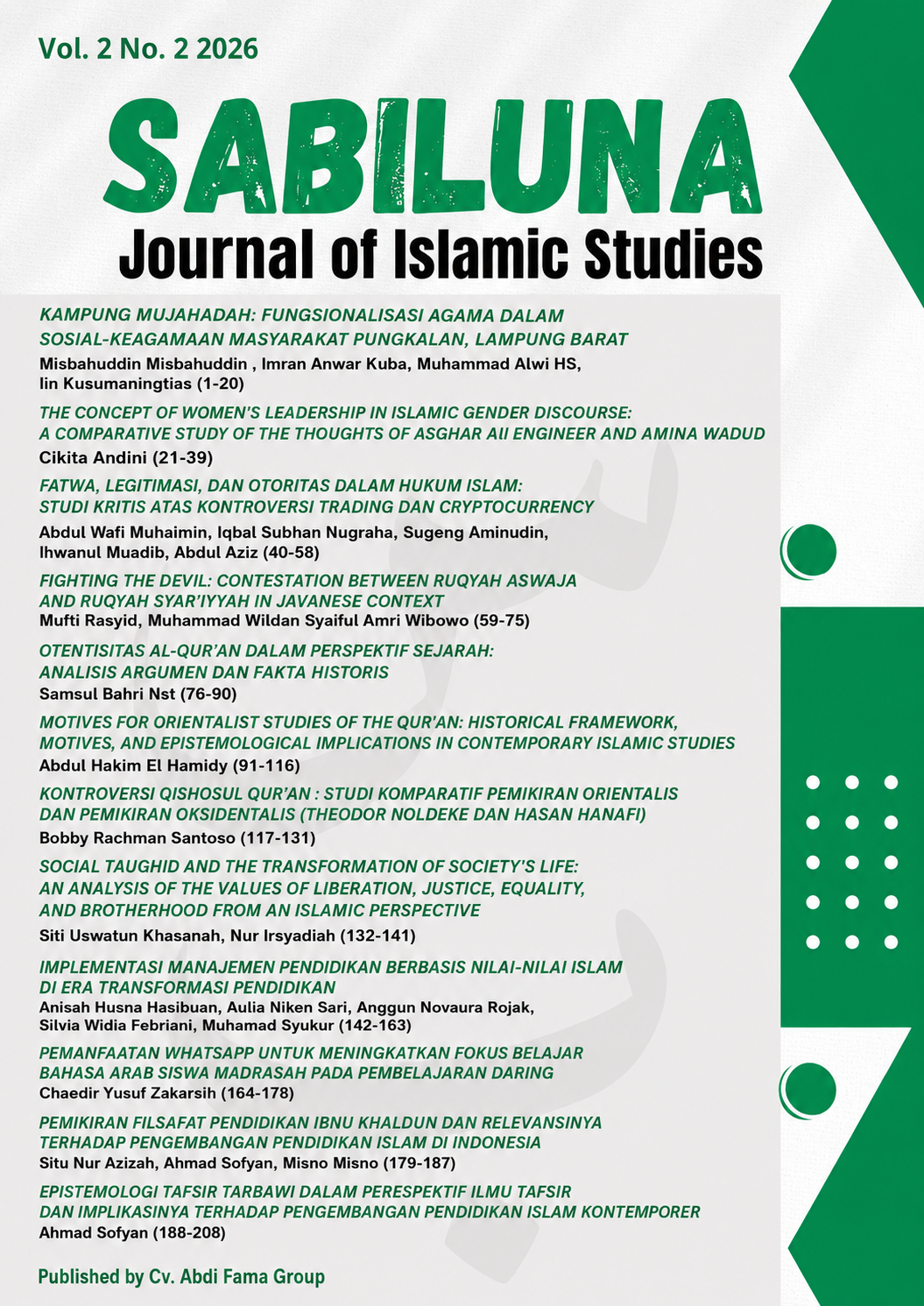
PEMIKIRAN FILSAFAT PENDIDIKAN IBNU KHALDUN DAN RELEVANSINYA TERHADAP PENGEMBANGAN PENDIDIKAN ISLAM DI INDONESIA
Keywords:
Ibn Khaldun, Piloshopy of Education, Islamic Education, Educational DevelopmentAbstract
This study aims to analyze Ibn Khaldun’s philosophical thoughts on education and their relevance to the development of Islamic education in Indonesia. The study employs a qualitative approach using library research. Primary data sources come from Ibn Khaldun’s works, particularly Al-Muqaddimah, while secondary data were obtained from relevant books and scholarly articles. Data were collected through documentary analysis and analyzed using content analysis. The results indicate that, according to Ibn Khaldun, education is a gradual process of human development focused on intellectual growth, moral character, and social skills. The purpose of education is not merely to master knowledge but also to shape individuals of good character, who are civilized, and capable of contributing to society. The educational methods proposed include gradual learning (tadrīj), repetition of material (takrīr), and adaptation to the psychological conditions of the students. Furthermore, teachers are viewed as role models who play a strategic role in shaping students’ character and personality. Ibn Khaldun’s ideas hold strong relevance for the development of Islamic education in Indonesia, particularly in strengthening an integrative curriculum, implementing humanistic teaching methods, fostering character development, and improving the quality of educators. Thus, Ibn Khaldun’s educational concepts can serve as a philosophical foundation for addressing the challenges facing Islamic education in the modern era.
Downloads
References
Ansorullah, A, Daud Ridwan, Siti Qomariatul Munawaroh, and Febry Suprapto. “Konsepsi
Pendidikan Dalam Filsafat Sosial Ibnu Khaldun Dan Relevansinya Terhadap
Transformasi Pendidikan Modern.” Tarbawi Jurnal Pendidikan Islam 1, no. 1 (2025):
86–96. https://ejournal.insuriponorogo.ac.id/index.php/ssa/article/view/6091/3296.
Fahmi, Fauzan Nur, and Ahmad Sukandar. “Holistic Education in the Perspective of Ibn
Khaldun : The Relevance of the Concepts of Tadrij, Takrir, and Asabiyyah.” At Turots :
Jurnal Pendidikan Islam
7, no. 1 (2025): 605–17.
https://doi.org/https://doi.org/10.51468/jpi.v7i1.1046.
Husein, Saddam. “Educational Construction in Ibn Khaldun’s Philosophy: Literary Analysis
and Contribution to Contemporary Islamic Education.” Al-Iltizam: Jurnal Pendidikan
Agama Islam 9, no. 2 (2024): 220–28.
Lely Nurarifah, Syaefudin, Sedya Sentosa. “IMPLEMENTATION OF THE INDEPENDENT
CURRICULUM AT INDONESIA : ANALYSIS OF RELEVANCE THE
APPLICATION OF IBNU KHALDUN’S EDUCATIONAL METHOD.” Potensia
Jurnal Kependidikan Islam 10 No 1 (2024): 1–19. https://ejournal.uin-suska.ac.id/index.php/potensia/article/view/25731/10710.
Rika Nia Adina, Wantini. “Relevansi Pemikiran Pendidikan Ibnu Khaldun Pada Pendidikan
Islam Era Modern.” Ideguru Jurnal Karya Ilmiah Guru 8, no. 2 (2023): 312–18.
https://doi.org/https://doi.org/10.51169/ideguru.v10i3.
Rohmah, Roisah Maulidiyah. “Pemikiran Pendidkan Ibnu Khaldun Dan Implementasinya
Dalam Dunia Kontemporer.” Jurnal Sains Student Reseacrh 2, no. 6 (2024): 565–76.
https://doi.org/https://doi.org/10.61722/jssr.v2i6.3029.
Theodora indah jati, Rayi Ambarwati. “Pemikiran Ibnu Khaldun Tentang Pendidikan Dan
Relevansinya Dalam Sistem Pendidikan Kontemporer.” Social Science Academia 2, no.
2 (2024): 251–62. https://doi.org/10.37680/ssa.v1i1.2471.
Downloads
Published
How to Cite
Issue
Section
License
Copyright (c) 2026 Situ Nur Azizah, Ahmad Sofyan, Misno Misno

This work is licensed under a Creative Commons Attribution-ShareAlike 4.0 International License.